A NEW WEBSITE!

As of March 2015, an official website for Surrey Moths has been set-up here. There you'll find information on everything to do with the Surrey Branch of Butterfly Conservation, including the updated events calender for 2015. Hope to see you there!


Thursday, 3 April 2014

Blossom Underwing


Many thanks to Richard Bartlett for this image of a smart Blossom Underwing caught in his Nutfield garden on the 1st April (it's certainly no April Fools!). Whilst moths caught on the south coast are often believed to be migrants, our Blossom Underwings are no doubt part of the resident population. Unlike similar early-season Orthosia, this is far from a common 'garden moth', and as far as I'm aware is only well distributed in more rural parts of the county where it requires mature oaks for the larvae to feed on. 

Friday, 28 February 2014

Surrey Moths Facebook Page

Following a discussion on the Surrey Moths Yahoo Group, I have now set up a Facebook Group specifically for Surrey Moths.

If anyone is interested in anything moth or moth-related in Surrey, then please do come along and join us!

https://www.facebook.com/groups/SurreyMoths/

Thursday, 12 September 2013

Bits and Bobs...

First of all, apologies for the lack of updates from me this year. It's been a busy summer, with little time spent standing still! After coming off Fair Isle in late May, I was offered the chance to return as a volunteer at the island's bird observatory for a month- a dream opportunity that I was never going to turn down (feel free to have a read about my work on Fair Isle on my blog). Leaving Fair Isle in late July, I then headed over to California for a couple of weeks of sun, sea and beer. Poor me.

In between the travelling, I have kept an eye out for moths, even managing a few unusual ones...

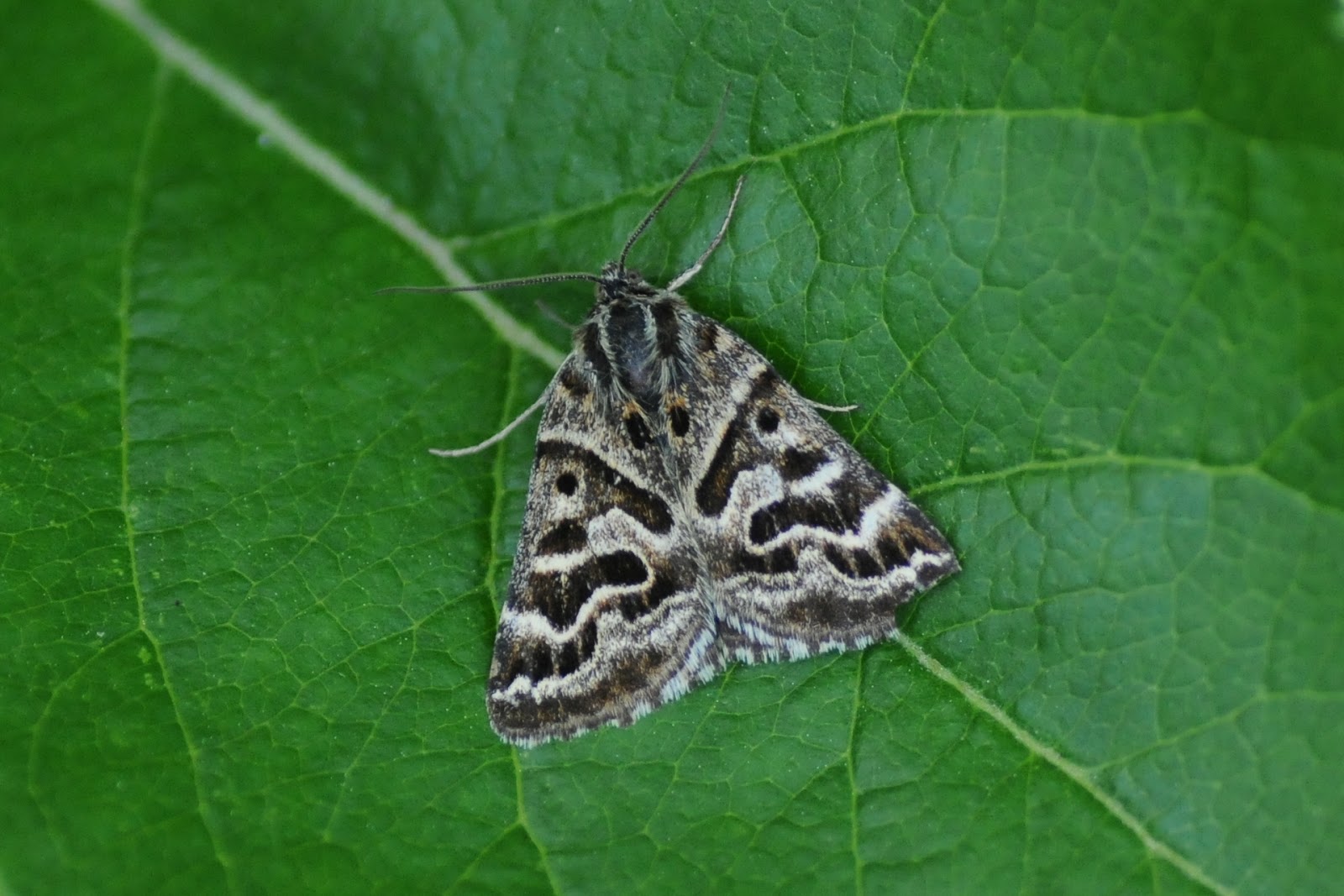
It was a bit of a surprise when this Mother Shipton, a moth usually found in open grassland, literally dropped out of the sky onto the garden lawn whilst I was eating lunch back in early June...


This smart looking micro, Ethmia quadrillella, caught in the garden on 21st August, turned out to be the first record of the species for Surrey. It's a scarce moth, confined mainly to fens and wetlands towards the east of England, but also has a tendency to arrive in Britain as a migrant- explaining the few other records from counties along the south coast. This one arrived on the same night as my highest ever single migrant count of 14 Diamond-back Moths and a Silver Y.


Aristotelia ericinella, caught on the same night as the above. A heathland speciality, probably bred from cultivated heather in a nearby garden- as can be said for a few White-line Darts and a Heath Rustic also caught this summer.


It's been a poor year for Hoary Footman in the garden compared to previous seasons, with only three individuals caught (including this one), and a bad year for footmen in general with no records of Buff Footman, and more surprisingly no sign of any Common Footman. I have recorded Hoary as late as 15th October, so there is still time for a revival...


And finally, this Yarrow Pug from 23rd August took the garden moth list to 500 species!


I'm afraid this will most likely be my last update from north Surrey till at least the end of the year as I'll be moving in to Uni this Saturday! Cheers all for reading the blog. Keep it up!

Happy mothing!

Sunday, 14 July 2013

the heart of the matter


I've not been very active this year so far... but I decided to have the trap out on Friday and Saturday nights. I had some nice, though not uncommon, moths on Friday. Yesterday, I had a few different species including a Red Data book species - heart moth. It's seven years since my one and only earlier sighting. Much to my surprise, someone emailed me from the west country to ask if he could 'twitch' it - but I'd let it go by then. I'm still slightly reeling at the thought that someone would travel for a couple of hours to look at a moth in a pot; and only an inch long at that.
I have to admit that the photos aren't terrific. I was fighting intense sun-light which had a tendency to bleach colours out.
I've added one or two other shots from around my garden (Odonata) and the area (larvae).

Female emperor laying eggs

grey/dark dagger - cannot be separated without dissection
barred straw

azure damselflies mating
Eudonis porphyrana


Heart moth - rare and elusive


angle shades larva on our Pyracantha


Surrey moth-er, now on Portland!

Hi all,

I did say i'd let you know when I started my new blog for my adventures on Portland.  Well here it is http://theportlandnaturalist.blogspot.co.uk/  Been going a week now.  Plenty of moth stuff, alongside everything else!

Shame young Bill has deserted you for a far-flung bird observatory, oh wait.

Cheers!

Saturday, 13 July 2013

A Berrylands Bonanza

This last week at the station has easily been the best of the year both in terms of quality and quantity, the macro yearlist now stands at 57 with the highlights of the week including a Small Ranunculus on July 10th, the fourth consecutive year this species has put in an appearance, I've also had in in previous years at Earlsfield and Raynes Park stations so I'm guessing it must be fairly well established in the suburbs. A Cypress Carpet turned up on July 12th, the third station record following on from the two I had last year and the rarest of the lot (in a Berrylands context) a Blue-bordered Carpet, the second station record following on from the first in 2009.


Blue-bordered Carpet


Cypress Carpet


Small Ranunculus


Wednesday, 12 June 2013

Rivu-lots

A nice session mothing on Merrow Downs, Guildford, last night. The most notable macro presence was the sheer number of Grass Rivulet, with 80 in one trap alone.  In our 5 traps we managed c80 species (I've forgotten a few!) under mostly cloudy skies:


11th June, Merrow Downs:

Macros:
30 Common Swift
1 Oak Hook-tip
1 Pebble Hook-tip
5 Cream Wave
4 Red Twin-spot Carpet
2 Silver-ground Carpet
1 Garden Carpet
4 Common Carpet
1 Common Marbled Carpet
1 Grey Pine Carpet
1 Broken-barred Carpet
60 Green Carpet
2 Pretty Chalk Carpet
110 Grass Rivulet
1 Foxglove Pug
1 Mottled Pug
2 Shaded Pug
1 Yellow-barred Brindle
1 Brown Silver-line
1 Scorched Wing
5 Brimstone (including a fresh, completely white individual, with retained dark markings)
2 Scalloped Hazel
2 Peppered Moth
1 Pale Oak Beauty
3 White-pinion Spotted
5 Clouded Silver
1 Lime Hawk
15 Small Elephant Hawk
1 Iron Prominent
1 Pebble Prominent
2 Marbled Brown
3 Pale Tussock
10 Orange Footman
4 White Ermine
2 Buff Ermine
6 Heart + Dart
4 Shuttle-shaped Dart
6 Flame Shoulder
1 Large Yellow Underwing
2 Ingrailed Clay
1 Setaceous Hebrew Character
1 Shears
1 Sycamore
1 Dagger sp.
1 Angle Shades
4 Minor sp.
5 Middle-barred Minor
1 Spectacle

Micros:
4 Nematopogon swammerdamella
2 Monopsis weaverella
1 Aspilapteryx tringipennella
1 Argyresthia trifasciata
3 White-shouldered House Moth
4 Elachista argentella
1 Agonopterix arenella
1 Teleiodes diffinis
4 Cochylimorpha straminea
1 Agapeta hamana
1 Eupoecilia angustana
1 Cnephasia sp.
2 Celypha lacunana
1 Bee Moth
10 Hypochalcia ahenella
3 Crambus pascuella
3 Crambus lathoniellus

Sunday, 9 June 2013

Nightjars the highlight again!

Last night, I thought it might be worth trapping after our Nightjar walk at RSPB Farnham Heath, though the weather was not ideal.  Unlike in the past, I did not have my generator, so I had to make do with using the power from the office, which meant the location was not the best.

Nonetheless, after a brilliant Nightjar walk in which I got my best views ever, I left the trap running overnight, and opened it up in the morning to a good number of moths.

Nothing spectacular, but 95 moths of 32 species is a good haul all things considered.

Farnham Heath, 8th June:
Macros:
16 Narrow-winged Pug
13 Grey Pine Carpet
8 Orange Footman
8 Shoulder-striped Wainscot
4 Pale Tussock
3 Common Swift
3 Treble Lines
3 White Ermine
2 Buff-tip
2 Tawny-barred Angle
2 Flame Shoulder
2 Birch Mocha
2 Spruce Carpet
2 Fox Moth
2 Clouded Silver
1 Peppered Moth
1 Brimstone
1 Cinnabar
1 Pine Hawk
1 Spectacle
1 Grey Pug
1 Green Carpet
1 Heart + Dart
1 Light Brocade
1 Shuttle-shaped Dart
1 Common Pug
1 Red Twin-spot Carpet

Micros:
5 Scoparia pyralella
1 Brown House Moth
1 Nemophora degreella
1 Bacta sp.
1 Coleophora sp.
1 Notocelia cynobastella
1 Elachista canapennella

Nemophora degreella


Sunday, 2 June 2013

Three churrs for Alder moths at Leith

The first field trapping session of the year (which, thanks to the weather is much later than usual) was at the beautiful Leith Hill on the 31st.  I had an early-ish start the next morning, so wasn't going to bother going, that is until I heard the warden, Sam Bayley, was planning to attempt to ring Nightjars at the same time. 

We started to set up 5 traps in a 'string of pearls' type formation along the paths.  Sam set his nets up much further away, so our lights would not interfere with his efforts. 

The sun had barely set before we heard the first Nightjar.  There was one particular spot near one of Bob Arnfield's traps that was absolutely brilliant for them, and we were treated to a magnificent display by at least three birds, often flying about over our heads! They weren't bothered by our presence at all.  This was in the end a little frustrating, as sadly, Sam failed to catch any birds. In fact the spot he had chosen saw little activity!  We held the monopoly where we were!  I have never been to a site with so much activity from the nocturnal birds, beacuse in addition to the caprimulgus-fest, a couple of Cuckoos called late into dusk, and there were loads of Tawny Owl and Woodcock about.

Onto the moths.  It was a nice muggy evening to start with, but the sky soon cleared.  At first numbers appeared pretty poor (the story of the year so far it seems), but we actually accumilated a decent haul by the time we packed up at 1:30.  The highlights were a load of Alder Kitten, and 2 Little Thorn, both lifers for me.  I did see a few micro lifers, but it was a fairly poor night for micros in truth, with little variety.  I am unsure which ones were lifers, as my laptop has recently broken, so I don't have my life list to hand.

31st May, Leith Hill:
Macros:
6 Scalloped Hook-tip
3 Red Twin-spot Carpet
3 Common Carpet
1 Purple Bar
1 Small Phoenix
2 Red-green Carpet
7 Grey Pine Carpet
15 Green Carpet
2 Foxglove Pug
2 White-spotted Pug
8 Narrow-winged Pug
2 Little Thorn
1 Peppered Moth (intermediate form)
1 Common White Wave
1 Pine Hawk
6 Alder Kitten
2 Sallow Kitten
2 Pebble Prominent
2 Lesser Swallow Prominent
1 Coxcomb Prominent
2 Pale Prominent
9 Marbled Brown
2 Lobster Moth
20 Great Prominent
25 Pale Prominent
1 Orange Footman
1 Buff Ermine
3 Flame Shoulder
1 Light Brocade
1 Pale-shouldered Brocade
1 Common Quaker
1 Treble Lines
10 Nut-tree Tussock
1 Silver Y

Total: 146 of 34 species

Micros:
3 Nematopogon swammerdamella
1 Phyllonorycter harrisella
2 Elachista canapennella
30 Neofaculta ericetella
5 Syndemis musculana
1 Celypha lacunana
1 Scorparia pyralella

Alder Kitten


Little Thorn


In a couple of weeks time, I will be moving down to Portland, Dorset, so I will be leaving this blog.  Many thanks to all the blogs followers, and I hope you will continue to support it.  Thanks as well to all the other contributors to the blog, particularly Bill, who originally set it up and invited me to join.  Keep it going from strength to strength guys!

Once settled in, I will probably set up a new blog encorporating all my wildlife sightings from the island, and I will hopefully add a link here once it's started.

Tuesday, 14 May 2013

Toadflax Brocade at Berrylands Station

It's been a very slow start at Berrylands this year, Oak Beauty on April 9th and Dark Chestnut on April 15th were both station firsts and very welcome they were, but things picked up yesterday with a Brimstone Moth and a Toadflax Brocade, the fifth succesive year I've recorded this species here. The macro year list stands at 12 species but things should really start to pick up from now on

Nick

Friday, 10 May 2013

Dotted Chestnut, North Surrey


Caught this Dotted Chestnut back on the 7th May in the garden actinic trap, one of the few species that I've longed for every autumn/spring, but have never succeeded in finding, to the point where I'd given up all hope of catching one. It's always nice to stare into the trap and find a new moth, but I was extra chuffed when I lifted up an egg box to the sight of this enigmatic species, confined to woodland and heathland in parts of southern England.

Makes all the pointless early mornings sifting through Common Quakers and Hebrew Characters worth it!

Monday, 15 April 2013

Lazy Grey

Well, what an appaling spring we've had in terms of weather.  As a result, I have not trapped at all this year (although to be honest, I have also been a little lazy too!).  That was until last night, where, in my new garden, I got a modest first catch of 28 moths of 8 species.

Here's to a good mothing year!

14th April:

Macros:
11 Common Quaker
6 Hebrew Character
4 Early Grey
2 Clouded Drab
2 Small Quaker
1 Brindled Pug

Micros:
1 Diurnea fagella
1 Light Brown Apple Moth
(+ 1 Common Plume whilst setting up)

Early Grey

Tuesday, 9 April 2013

So quiet!

You can tell by the lack of blog posts here how dismal the mothing has been of late.

But things seem to be picking up at and the last two nights have seen some moths in the trap, particularly Oak Beauty and Small Quakers.  Last night was particularly pleasing though with some 24 Small Quaker, 3 Oak Beauty, a Clouded Drab, Hebrew Character, a Twin-spotted Quaker and a Herald...let's hope it lives up to its name!


Herald


Wednesday, 20 March 2013

The Confessions of a Beginner

"My mothing area lies south of Chiddingfold and almost in sight of the Sussex border. I started trapping  a couple of years ago because once the butterflies had disappeared I was faced with several months with nothing to see before they returned with the spring.  There is only so much excitement that can be generated by the sight of a solitary Red Admiral on a sunny winter's day.

Exactly a year ago I took 220 Small Quakers (Orthosia crudain) in my Heath trap with a 20w actinic bulb and over 100 in a Robinson. So far this year I've managed to take just 1 in about 10 nights trapping. 


Several of the usual suspects have appeared, the micro moth Tortricodes alternella commonly turns up, always making me think that at least one of the specimens taken should be something else and no matter what I do always too lively to pose for a photograph. Maybe for this photo of a Yellow-Horned (Achlya flavicornis) I should have taken a head-on police mug shot but he showed every indication of also wanting to escape.


I have a soft spot for the Brindled Beauty because it is the first moth that I ever photographed in its natural setting and so much more colourful in daylight  (Lycia hirtaria)


Small Brindled Beauty (Apocheima hispidaria)


But a more frequent visitor to the trap in January was the Pale Brindled Beauty (Phigalia pilosaria)


There have been a smattering of rather worn Chestnuts (Conistra vaccinii) the darker forms of which tempt me to identify them as Dark Chestnut (Conistra ligula). Maybe I'll be lucky enough to have one of each one night so that I can see the difference in the wing shape. The March Moth (Alsophila aescularia) has appeared in small numbers on several nights.


With a little luck and if the forecast is to be believed I might get another night suitable for trapping before the end of the month and  now that the Field Guide to the Micro moths of Great Britain and Ireland has been published as well as the Smaller Moths of Surrey, I almost look forward to a micro moth or two"

John R

Many thanks to local trapper, John, for sharing his brilliant early season catches. 

Thursday, 8 November 2012

Leps of Down Under

I've just got back from two weeks in New Zealand, but I wasn't going to make a post about this trip, as its about as far from Surrey as your likely to get!  But, as Bill has requested it, I'll do a quick review.

In terms of the wildlife, of course the main interest was the birds.  They were indeed amazing, and see here for a trip report: http://www.birdforum.net/showthread.php?t=244125 I didn't spend too much time looking for lepidoptera, and remember that the time of year was thier equivalent of late April/early May, so there were not a great number of species on the wing.  I ended up identifying two moths, and three butterflies. 

The aptly named New Zealand Red Admiral was very common, but the Common Tussock (which I didn't get a photo of) was only seen at one site.  The Boulder Copper is apparently NZ's commonest butterfly, but it's also thier smallest so its easily overlooked (about the size of Small Blue).  The Helastia cinerearia was a day-flying moth, but the ID is rather tentative, as the number of similar Geometrids is more overwhelming than here!  The Wiseana umbraculata was an easier ID, as its clearly one of the Swifts.  It came to a lighted window at night.

New Zealand Red Admiral
 
Boulder Copper (female)


Boulder Copper (male)
 
 
Wiseana umbraculata


Helastia cinerearia


As an aside (and on an insect theme at least) I made this interesting discovery.  I found this on a wall in a garden.  Its the empty egg-case of a New Zealand Praying Mantis (NZ has two species).  Unfortunately, I never saw any of the real thing.


Wednesday, 7 November 2012

Pluming Marvelous

I've just got back from a mothing session at Sheepleas with Bob Arnfield, Steve Spooner, and Andy Culshaw, where we ran an MV and an actinic trap.  We were there in order to target the Plumed Prominent, which was last found at the site in 2005.  The weather started off cloudy, but things were not looking good as it suddenly cleared, and we had had only three moths.  For no apparent reason, around 7pm, there was a flurry of activity that included the arrival of my first December Moths.  Then, I noticed an odd looking moth sitting on the MV trap.  It was it!  I was surprised at how small and un-prominent-like it looked.  This came shortly after both Bob and myself noticed a promising-looking moth flying around in a nearby mature Field Maple.  We ended with 18 moths of 6 species.  Not bad for November!

7th November, Sheepleas:
4 December Moth*
4 Red-green Carpet
3 Common Marbled Carpet
3 Brick
3 Chestnut
1 Plumed Prominent*

December Moth


Plumed Prominent

This is will probably be my last post this year.  Thanks everyone for supporting the blog, and have a great Christmas!

Sunday, 4 November 2012

PS

If you order the book from

http://www.surreywildlifegifts.org.uk/collections/atlas-series
all profits go to future atlases.

Saturday, 3 November 2012

New book

It would be remiss of me not to give a plug to the latest book on Surrey's moths - Smaller moths of Surrey by Bob Palmer, Jim Porter and Graham Collins. I have had the pleasure of doing some fieldwork with Jim and Graham, and they really know their stuff. Searching for near invisible 'micro-moths' may not be everyone's cup of t, but they bring a great deal of skill, knowledge, enthusiasm and persistence to the task. In fact they have been urging Surrey's mothing community to get out into the field during the season (roughly March till November) to collect as many 'dots' as possible for the atlas.

I am still a novice at identifying micro-moths but the new book by Sterling and Parsons (illustrated by Richard Lewington) is a big step in the right direction. It is called Field Guide to the Micro-moths of Great Britain and Ireland. Armed with these two tomes (and some £50 the poorer!) almost anybody should be able to start finding and identifying at least some of the micros. 

The Field Guide is published by British Wildlife Press and the Surrey atlas by the Surrey Wildlife Trust (order from their website).

The Atlas covers all of the 1,100 plus species that have been recorded in Surrey, out of a UK total of around 1,600. There is a map for most species, which gives a quick visual picture of the distribution. The text explains the scarcity or otherwise of each species and gives some basic information about the food-plants and how most of the records have been obtained.

I was pleased to discover that there are two species for which I have obtained the only modern records - in fact Argyresthia cupressella has only ever been recorded in my garden. (How much am I bid for tickets to search for this little moth which is about 6mm long?).

The book is hardback, and printed on better quality paper than Graham's earlier books in the series (butterflies and larger moths). There are some good photographs of a representative range of species, including one of my favourites, Alabonia geoffrella


Moths and the weather

Moths, I have concluded, don't mind torrential rain and howling winds.  However, drop the temperature a bit and you don't see them for dust!

During the dreadful weather on Wednesday night last week I trapped five Red-Green Carpets, five Yellow-line Quaker, a Feathered Thorn and a December Moth.  Thursday was a glorious day and relatively warm so I had high hopes but the temperature dropped dramatically in the evening and only one brave December Moth showed itself.

I have also now changed trap.  I was using a Skinner but a couple of months ago my partner and I had a go at making our own Robinson-type trap which I am now using - works a treat!


Robinson Trap


Friday, 5 October 2012

Agent Orange

Went for a short evenings trapping at Stoke Meadows last night, but numbers were very poor.  The forecast looked decent, but the temperature was rather disappointing in the end.  Luckily, the very last egg box removal saved the day.  Under it was a lovely Orange Sallow, which was my first.

4th October, Stoke Meadows:
4 Snout
2 Common Marbled Carpet
2 Barred Sallow
2 Large Yellow Underwing
1 Angle Shades
1 Herald
1 Silver Y
1 Orange Sallow
1 Setaceous Hebrew Character
1 Chestnut


Orange Sallow
 

Next week I will be going to Provence for the week (for birdwatching).  Imagine my glee when I found out that the accommodation comes with its own moth trap!  Not sure if the weather will lend itself to trapping, but I'll certainly do a short post on my return if I trap and get anything good.